

Starting with a story…
This week reminded me again how much mathematics can emerge from the simplest of resources.
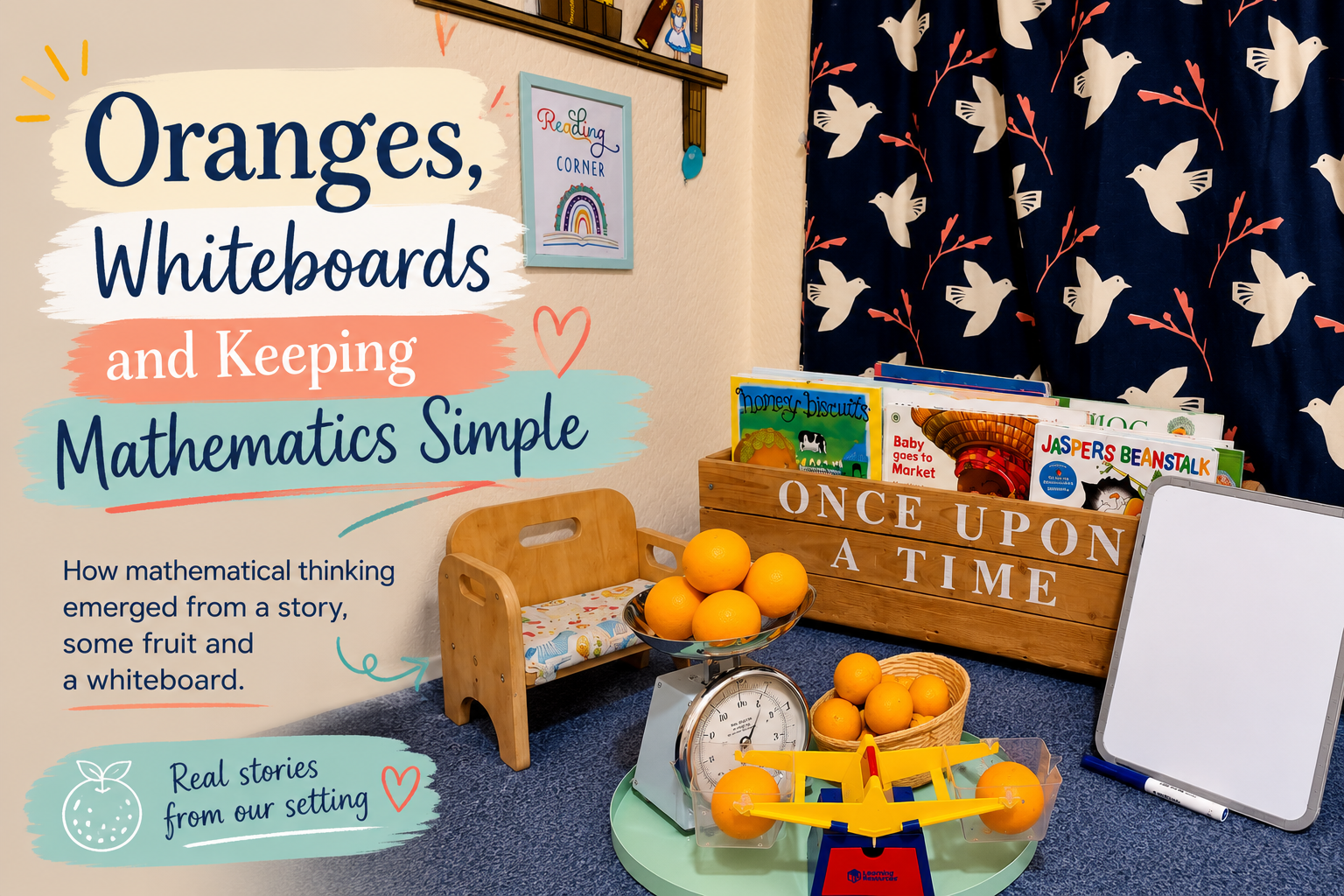
Our planned curriculum book was Baby Goes to Market. As part of the provision, I gathered together a selection of items linked to the story, including some real oranges. As we shared the book, the children quickly noticed the mathematical pattern running through it. Baby is given a collection of items, eats one, and places the remaining items into the basket. Six bananas become five. Five juicy oranges become four. Four chin-chin biscuits become three. Throughout the story, the quantity changes each time.
The oranges quickly became a favourite.
The book describes them as juicy oranges, which sparked a discussion about what juicy actually means. Before long, we were exploring the oranges themselves, feeling them, squeezing them and tasting orange segments to find out whether we agreed with Baby’s description. The mathematics was embedded within the story, but the children’s curiosity had firmly settled on the oranges.
I handed each child a whiteboard and marker pen and suggested drawing some of the oranges from the story.
What followed reminded me how quickly mathematical thinking can emerge when children are exploring something that genuinely interests them.
The older children immediately began writing their names, something that has become a familiar part of our mark making. The younger children quickly followed their lead. Soon afterwards, some of the older children were attempting to write the word oranges using their developing phonic knowledge, again prompting interest from the younger children.
What interested me most, however, was the mathematics that began to emerge. The children were not simply drawing oranges. They were drawing quantities of oranges. Some carefully counted as they drew. Others compared their collections with friends. Some were more interested in telling me how many oranges they had altogether. The marks on the whiteboards were no longer simply marks. Increasingly, they were being used to represent quantities that had meaning to the children.
Looking back, it is interesting how often the quantity of four reappeared over the following few days. In the story, Baby receives five oranges, eats one and places the remaining four into the basket. At the time, this felt like a small detail. Later, it seemed to surface again and again in the children’s play and investigations.
Revisiting the Idea Through Play…
A few days later, Handa’s Surprise gave us an opportunity to revisit a very similar mathematical idea in a different context.
Using puppets, felt fruit and small baskets, we brought the story to life together. We balanced baskets on our heads like Handa and re-enacted the events of the story. As each animal helped itself to a piece of fruit, we watched the basket change. There was one fewer fruit left each time. The language of fewer emerged naturally because the children could see the quantities changing in front of them.
What struck me was how confidently they engaged with the idea. It was not new learning being introduced for the first time. The children had already spent the previous few days counting collections and noticing what happened when one item was removed.
The following day, a bowl of oranges, some tangerines and a set of balance scales took the learning in a completely different direction.
We placed one large orange on one side of the scales and began adding tangerines to the other.
One wasn’t enough.
Neither were two.
Three still didn’t balance the scales.
The fourth finally did.
That simple discovery opened up a rich mathematical discussion. The children made predictions, tested their ideas and compared quantities. We discussed what it meant when the scales balanced and why four smaller fruits could balance one larger one.
The conversation shifted again when we cut the orange into four equal parts. We talked about sharing fairly and making sure everybody received the same amount. What had started as an investigation using the scales quickly became a discussion about equal parts, equality and fairness.
We then squeezed the oranges to make fresh orange juice, adding another real and meaningful experience to the learning.
Later, while playing with a toy cake, I overheard children discussing how to cut it in half. The conversation quickly moved on to whether each piece would then need to be cut in half again so that everybody could have the same amount.
That moment stayed with me.
The oranges had gone.
The scales had been put away.
Yet the mathematical thinking remained.
Looking back, what strikes me is how much mathematics emerged from a small thread that began with a story. We explored changing quantities, representation, comparison, balance, equal parts and sharing, but none of these ideas were introduced as isolated activities. They emerged through stories, conversations, play and investigation.
Perhaps the most important reminder for me was that the mathematics was there all along. It was sitting inside the pattern of the story, inside the marks on the whiteboards, inside the fruit, the scales and the conversations that followed.
Sometimes, in our search for the next activity, it is easy to overlook the mathematical opportunities already sitting in front of us.
This week, they happened to be oranges. 🍊