- July 10, 2026
- Joanne Hall (Staff)
- 0
At first glance it was just a floor puzzle. Looking back, it became something much more.
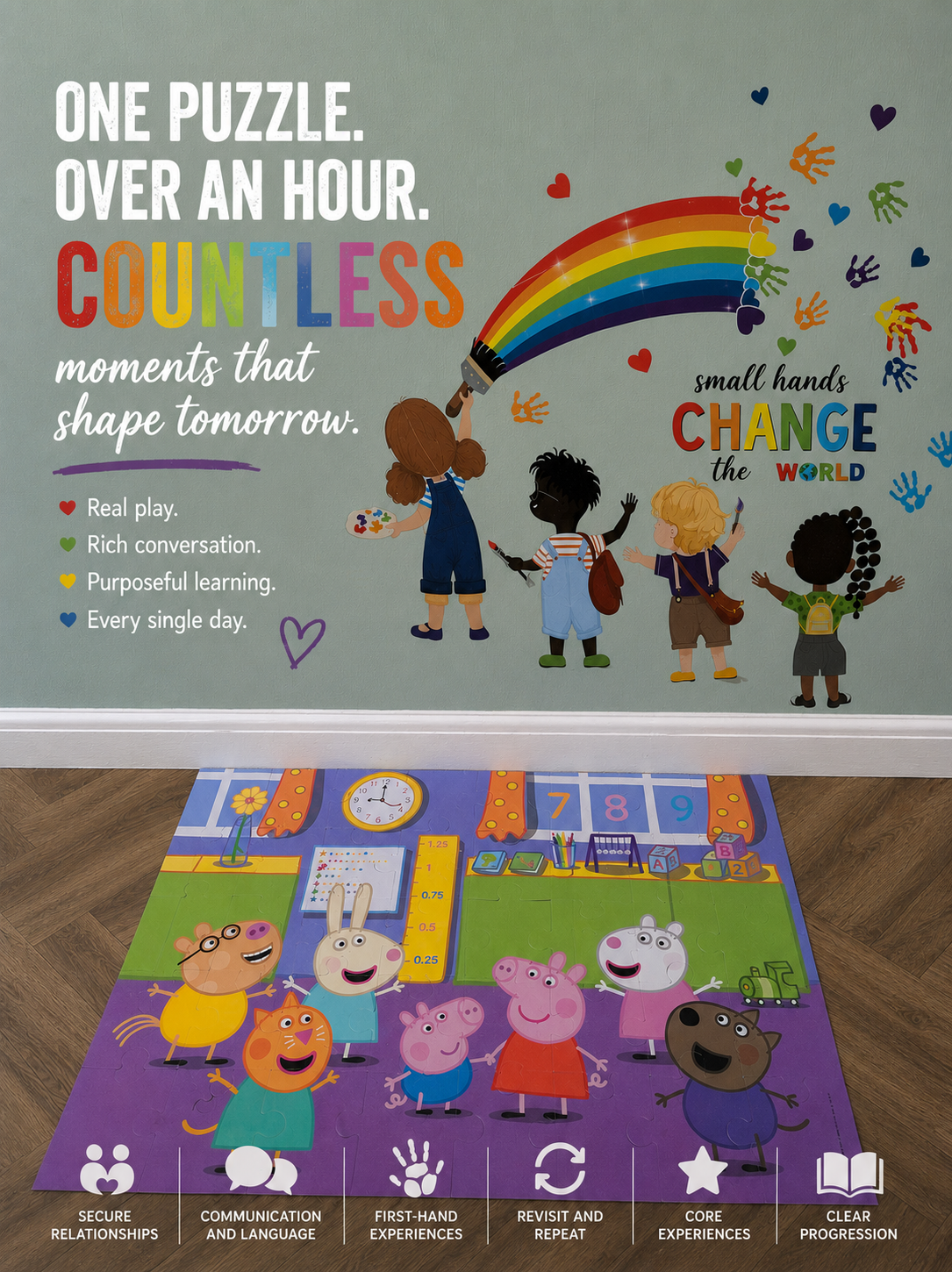
One day this week, we spent over an hour completing a large Peppa Pig floor puzzle.
When I tell people that, they often assume one of two things…
Either it must have been a very difficult puzzle.
Or we must have spent an hour trying to finish it.
Neither was true!
In reality, the puzzle became almost incidental.
What held everyone’s attention wasn’t the challenge of fitting the pieces together. It was everything that happened around it.
Learning Beyond the Puzzle
As we worked, we talked about where the characters were and how they might be feeling. We discussed their facial expressions and used because to explain our thinking.
We noticed the flowers in the picture and linked them back to our learning about growth and the important role bees play in helping flowers to grow. We talked about what time of year it might be and how we could tell. Because the puzzle was set in a school, the older children also reflected on how much they had grown themselves. We talked about starting school, how they were feeling about the transition and how much they had learned since they were younger.
We noticed the height chart on the classroom wall and compared it to our own heights, measuring everyone against the door and talking about taller and shorter.
The spotty curtains reminded us of other patterns around the room. We compared them with the stripy and spotty T-shirts on our wall display before noticing the striped pattern on the toy train.
The mathematics continued naturally throughout the experience. We counted the stars on the reward chart, compared more and fewer, counted legs and practised doubles with the older children. We counted arms and noticed that the number of arms matched the number of legs. We counted ears and recognised that everyone had two.
The puzzle also prompted conversations about diversity. We noticed one character wearing glasses and immediately compared this with photographs on our own wall display. We talked about different hairstyles, including short hair, long hair and afro hair, before discussing how everyone’s appearance is unique.
As we manipulated the pieces, we talked about straight sides and corners. We counted the cat’s whiskers. We noticed one character’s big smile and talked about looking after our own teeth.
When the puzzle was complete, nobody announced that the learning had finished.
Instead, everyone chose to draw their own Peppa Pig pictures before we shared one of our new Peppa Pig books. This particular story included symbols alongside the text and introduced a character wearing hearing aids, creating further opportunities for conversation, early literacy and inclusion.
The Bigger Picture
Looking back, what strikes me most isn’t how many curriculum areas we covered.
It’s how naturally they emerged.
Communication and language wasn’t a separate activity.
Neither was
- Mathematics.
- Understanding the World, or
- Personal, Social and Emotional Development.
They were woven together through one shared experience.
More importantly, they weren’t new ideas. They were opportunities to revisit, connect and deepen learning that had been developing throughout the term.
Sometimes, I wonder whether we move children on too quickly.
Not because the learning has finished.
But because the activity has.
Those are not the same thing.
Curriculum
A coherent curriculum isn’t built through a series of disconnected activities. It’s built by returning to important ideas, making meaningful connections and allowing children time to think, talk, notice and revisit what they already know.
Perhaps that’s why the puzzle held everyone’s attention for so long.
It wasn’t really about completing a puzzle.
It was about the conversations that grew around it.
Maybe the question isn’t…
“How long should this activity take?”
Maybe the better question is…