

- February 27, 2026
- Joanne Hall (Staff)
- 0
The Four Guiding Principles of the EYFS: Why They Matter More Than We Sometimes Realise.
I still remember sitting in a secondary school hall in 2008 during early EYFS training. The trainers introduced the four guiding principles: the unique child, positive relationships, enabling environments and learning and development. Like many practitioners at the time, my attention went first to the learning and development outcomes.
There is something reassuring about a list, and something satisfying about being able to say a statement has been achieved. In everyday practice, of course, the other principles were always present. Working with relationships, environment and knowledge of the child is woven into early years provision. At that stage, though, they often felt like the background, while outcomes felt like the part to be evidenced.
Over the years, through experience, training and reflection, that balance shifted. The more closely I worked alongside children, the clearer it became that the guiding principles are not separate at all. They only function effectively when they operate together. The revised EYFS has strengthened this message. The move away from excessive documentation has not lowered expectations. Instead, it places greater emphasis on professional judgement, proportionate assessment and close observation of children’s learning in the moment. Occasionally, a moment in practice makes this interaction between the guiding principles unmistakably clear.
One such example began quietly, and it began with shared books during free play.
The Unique Child: Noticing How a Child Wants to Learn
When a toddler joined my setting, spoken language was minimal. The child was settled and engaged in play but rarely used words across the session. We had already begun considering ways to support communication, and I initially planned to use familiar storybooks and adult-led language modelling. The turning point, however, did not come from a planned language activity. During free play I noticed the child sitting closely with a peer in a quiet corner, sharing familiar character books. They were calm and absorbed. The slightly older child used simple words and short phrases, and the toddler began to copy and join in. What was significant was not simply that language emerged, but how it emerged. Communication occurred in a quieter space, with shared focus, low pressure and a peer model. This was the unique child in practice: recognising that learning is not only what we teach, but also where, when and under what conditions a child is able to demonstrate their learning.
Positive Relationships: The Adult Role in Supporting Communication
The next step was not to take over the interaction but to respond to it carefully. My role was to observe closely, avoid interrupting unnecessarily and consider how this communication could be supported to occur again. Positive relationships in this situation meant being attuned, responsive and predictable enough that the child could communicate without feeling directed or assessed. The peer interaction was important, but the adult role was equally important. It was the practitioner who noticed, valued and safeguarded the opportunity for communication to continue meaningfully.
Enabling Environments: Using Communication-Friendly Spaces
The observation prompted reflection on communication-friendly environments, including training influenced by Elizabeth Jarman’s work. The environment itself appeared to be reducing communication pressure.
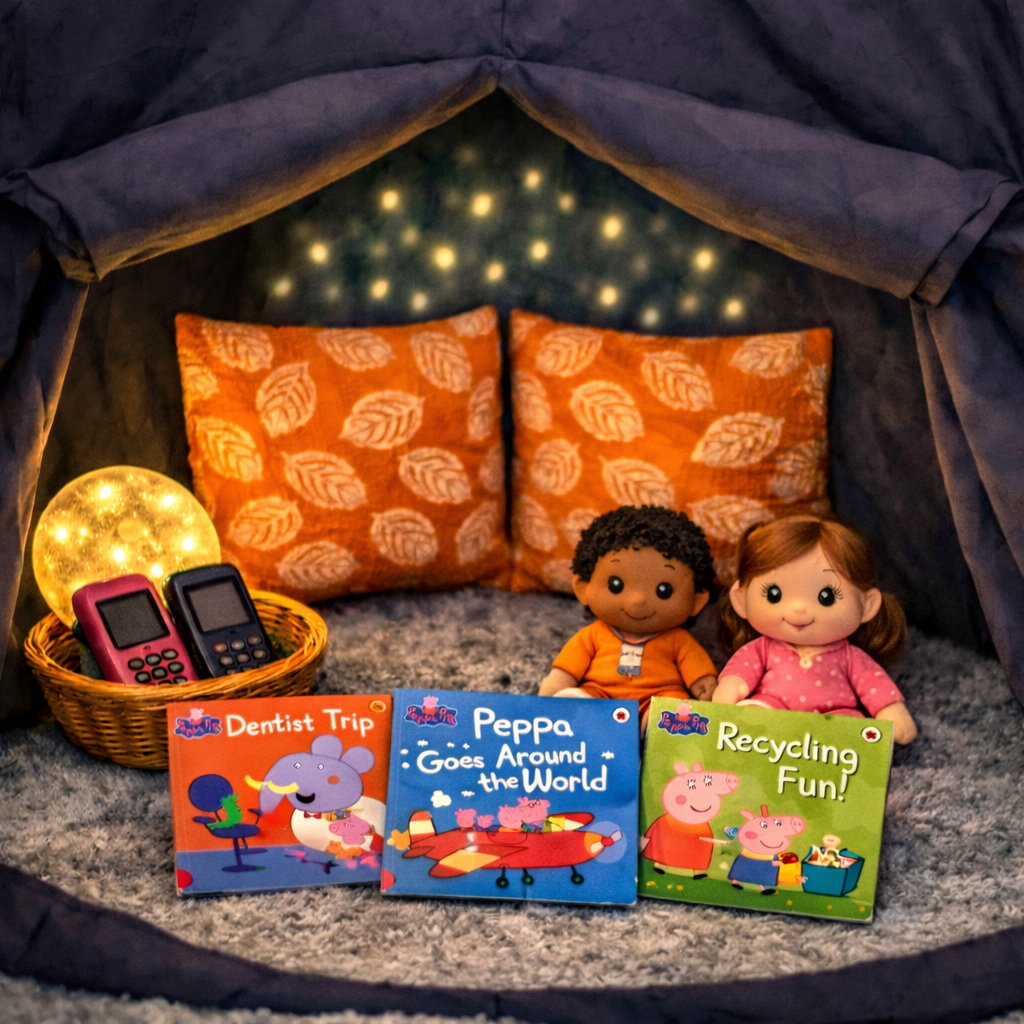
I therefore created a calm enclosed space: a dark tent with soft lighting, cushions, comfort items and familiar books, with room for a peer to join. The impact was immediate. The child spoke more freely when the tent was closed. A practitioner remained nearby for supervision, but the reduced sense of being watched appeared to support communication. Over the following days the provision was adapted in response to observation. Initially communication occurred with one peer at a time. Later I was able to join the child in the space. Replica mobile phones were introduced, as role-play scenarios naturally encourage short conversational exchanges. Two-word phrases began to appear more consistently, first through imitation and then independently. This process involved continual observation, adjustment and reflection rather than following a predetermined sequence.
Learning and Development: Progress Beyond the Quiet Space
My original plan to structure communication support through a sequence of adult-led book sessions was no longer appropriate. The child had shown the conditions under which communication could develop. For the first few days language occurred predominantly within the quieter space. Gradually, confidence transferred into interactions with an adult and then into the wider room. Parents began noticing increased communication beyond the setting. The learning and development outcome was therefore not taught directly. It emerged because the unique child was understood, relationships were secure and the environment reduced pressure.
Reflection for Practice
It can be tempting to work backwards from an outcome: identifying a skill and selecting activities to teach it. This experience reinforced a different approach. Sometimes the most effective action is to notice what is already supporting learning and to build from it. The guiding principles are not theoretical ideas. They inform daily decisions: what we observe, what we adapt, and what we choose not to interrupt.
A shift occurs when the focus moves from How do I evidence this? to What is this child showing me about how they learn?
What This Means for Early Years Practice
This observation highlighted that high-quality communication does not always emerge from planned activities or adult-led interaction. In this case, the sustained peer dialogue occurred because the environment reduced social pressure and allowed children to communicate without interruption, performance expectation, or adult direction.
For practitioners, this suggests that supporting language development is not only about modelling vocabulary or asking questions. It also involves recognising when to step back, protecting shared thinking, and allowing children time and space to sustain interaction independently.
Simple environmental adjustments, smaller spaces, reduced visual distraction, predictable routines, and attentive but non-intrusive adults can significantly increase the quality of child-to-child communication. Observing how children initiate, maintain and return to conversations over time can provide stronger evidence of communication development than short adult-led exchanges.
Rather than creating more activities, practitioners may need to focus more carefully on enabling conditions: emotional safety, predictability, and uninterrupted time. When these are in place, children often demonstrate deeper language, longer conversational turns, and greater confidence in expressing ideas.
This shifts assessment from recording what adults have taught to noticing what children can sustain independently. In this way, everyday interactions become meaningful evidence of curriculum impact.
A Note on the Environment and Photographs
Following recent reflection on reducing routine photography, I have thought carefully about what we choose to share. The richest learning often happens when adults are observing rather than documenting. However, this does not mean the environment is unimportant. The tent, soft lighting and gentle projected star effect were chosen to create a calming, low-pressure space that supported communication. If it photographs well, that is incidental. The measure of its value is whether it helps a child feel secure enough to settle, connect and communicate.
An enabling environment is not defined by appearance but by function. We might ask:
- Can the child access it independently?
- Does it reduce pressure or add it?
- Does it encourage interaction?
- Does it support sustained engagement?
When the unique child, positive relationships and learning and development are considered together, the environment becomes more than a backdrop. It becomes an active part of learning.
Further reading and evidence
This reflection links closely to evidence on adult-child interaction and shared communication contexts: