

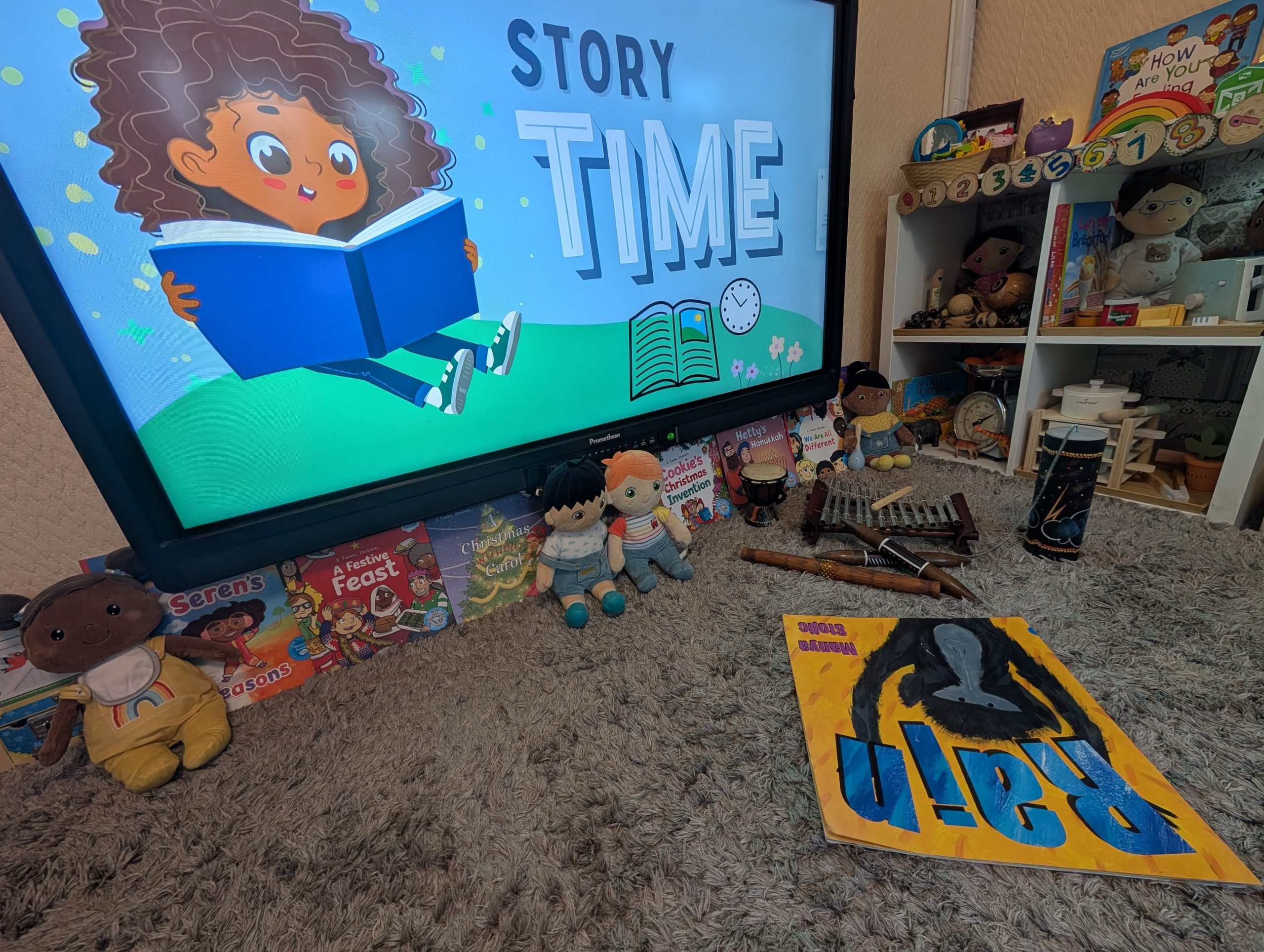
At Little Explorers, we continually evaluate our curriculum through its impact. Our practice has always been rooted in strong relationships, responsive teaching and high expectations; however, more recently, we have been deliberately slowing our pace to prioritise depth, simplicity and meaningful connections in learning. As a result, the impact of our teaching is now even more visible, sustained and transferable, with children increasingly recalling language, concepts and experiences accurately days later and applying their learning spontaneously in new contexts, both within the setting and beyond it. This depth of learning demonstrates how responsive, everyday practice can achieve meaningful and sustained impact.
As we reach the end of the year, our reflections have increasingly centred on how children build understanding over time, and how learning becomes most powerful when it is revisited, connected and carried beyond the immediate moment.
Following Curriculum Intent Through Simple Everyday Moments
As part of our ongoing curriculum focus on people and places around the world, we shared the book Rain by Manya Stojic. The book was chosen for its strong visual narrative and rhythmic repetition, which supported our youngest children through shared language, listening and sustained engagement, while also offering rich discussion opportunities for older children.
For younger children, the repetition, sound patterns and animal focus supported early communication and engagement, providing a secure foundation for shared attention and meaning-making. For older children, the story prompted thoughtful discussion about change and contrast, as the animals experience dry ground before the rain arrives. This opened up conversations about how places can feel different from where we live, how environments change, and how living things respond to those changes, supporting children to think beyond their own immediate experiences in an age-appropriate way.
The rhythmic language and repetition in Rain also supported our literacy curriculum, helping children to tune into patterns in language through shared, meaningful experiences.
What mattered most was not the book itself, but what it opened up.
In response to the children’s engagement, we spontaneously extended the learning. Musical instruments were introduced to recreate the sound and rhythm of rainfall, allowing children to express ideas through movement and sound. Mark making followed naturally, with children creating dots and marks to represent rain, giving meaning to their marks as part of a shared narrative rather than as an isolated task. These decisions were not pre-planned or resourced in advance; they came from being attuned to the children and having an enabling environment where resources were immediately accessible.
Impact Beyond the Moment
The impact of this learning became clear well beyond the session itself. Later in the week, one child, still emerging in language skills and under two years of age, independently made dots while mark making at home and clearly said “rain,” demonstrating a direct connection between the earlier experience and his own expressive communication. During the same week, the child attended a community music group with their parent and immediately associated shaken instruments with “rain,” clearly demonstrating meaningful transfer of learning into a different environment. This is how we know learning is secure: not because it was completed, but because it was remembered, re-used and communicated.
Building Conceptual Understanding Through Story
A similar pattern emerged through our shared reading of the book Whatever Next! by Jill Murphy. The story offered rich opportunities to explore vocabulary, sequence and emotion, but also to pause and extend learning in purposeful ways. We did not assume a shared understanding of the cupboard under the stairs featured in the story; instead, we actively went to find the cupboard under the stairs within the setting, exploring its location and discussing its function within a home. When the children questioned the meaning of the draining board mentioned in the story, we went into the kitchen to investigate a draining board together, linking directly back to the text.
Discussion about Baby Bear’s helmet and the rain going through it led to a spontaneous exploration using water, colanders and containers with different numbers of holes. Children compared the number of holes and how much water flowed through each container, using language such as “more,” “fewer” and “less,” embedding early mathematical thinking within a meaningful, real-world context.
Later that day, we deliberately revisited this comparative language through a planned maths session, reinforcing the concepts of more and fewer in a different, countable context. The impact of this was evident beyond the setting, when a carer later shared that their child had excitedly commented on seeing “one more roundabout” than usual on the journey home, demonstrating secure understanding and spontaneous application of mathematical language in everyday life.
The story’s reference to a picnic on the moon being “a bit boring” was intentionally explored. Adults recognised this as a valuable opportunity to model emotional language, and children discussed what “boring” might feel like and why. Later in the week, this language reappeared naturally when a child described an unrelated activity as “a bit boring,” demonstrating genuine understanding rather than rehearsed vocabulary. This prompted timely adult response and adaptation of the experience, demonstrating children’s growing confidence in using language to express preferences and needs.
Further evidence of impact emerged at home, where a child independently searched for the cupboard under the stairs at their own house after recalling the story, and requested boots as “space boots,” showing imaginative recall, language development and narrative connection.
Why This Matters
Across these experiences, the same principles consistently apply. Learning is strongest when it is rooted in everyday moments, responsive interactions and accessible resources. By resisting overly complex or heavily resourced activities that can unintentionally limit children’s thinking and opportunities for transfer, we create space for deeper understanding, creativity and connection.
This approach supports all children. Younger children benefit through sensory engagement, repetition and physical expression, while older children deepen their understanding of language, emotion, comparison and cause and effect. Differentiation happens naturally because the learning is open, flexible and responsive to each child.
A Reflection for Practitioners
What this reinforces for us is that curriculum does not live in paperwork, themed trays or carefully staged activities. It lives in conversations, stories, shared experiences and the confidence to pause, notice and extend learning when it matters most.
An enabling environment does not mean more resources; it means the right ones, accessible at the right time. A strong curriculum does not require constant planning; it requires professional judgement, attentiveness and trust in children’s capacity to make meaning.
The evidence of impact we are seeing — children recalling stories days later, using emotional language accurately, transferring concepts across settings and contexts — confirms that this way of working is not only effective, but sustainable
Keeping things simple is not a reduction in ambition; it is how curriculum intent is realised in everyday practice.