

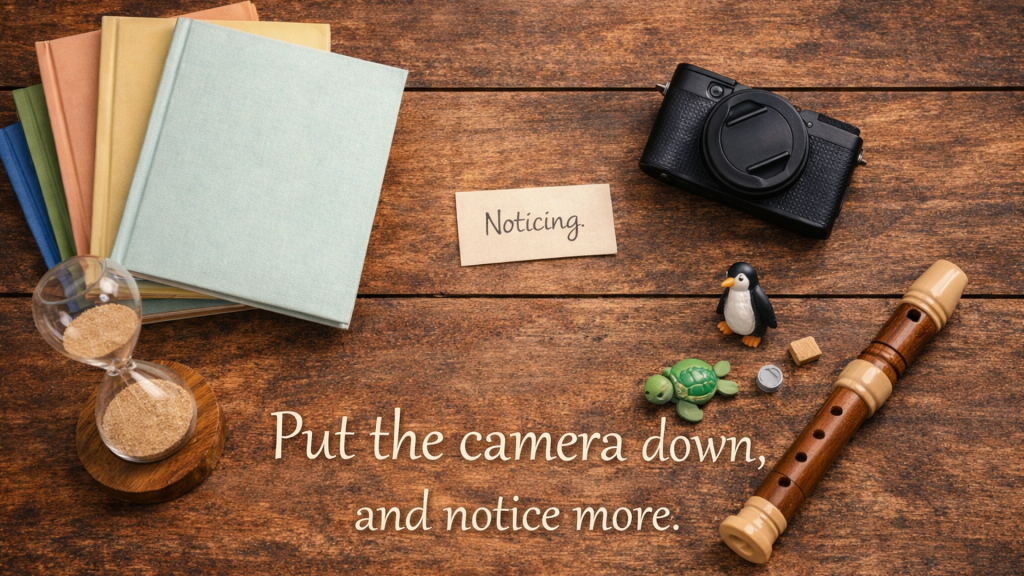
When the camera went quiet, the learning got louder.
This month, we made a deliberate decision to step back from routine photography. Not because photographs are wrong, and not because our practice needed fixing, but because we wanted to look more closely at where practitioners’ attention goes during the day.
Like many settings, we reduced paperwork in line with EYFS expectations and moved towards purposeful observation built on professional judgement. Photography, however, remained quietly present. So we agreed in advance to remove routine photography for January and watch what changed when practitioners were no longer carrying that extra demand alongside children’s learning.
The impact was a subtle shift away from presenting learning and towards protecting it. This was our aim from the start: we have not reduced photography because less is happening, but because more is.
To be clear, this is not a criticism of what came before. It is a refinement of practice based on the EYFS emphasis on professional judgement and keeping observation proportionate, so practitioners can stay focused on children’s learning as it happens. A key part of this reflection is what we noticed during the trial: routine photography added extra decisions into the moment. Without that routine expectation, we could stay with the learning and respond more quickly when opportunities appeared.
Our Spontaneous Fire Engine Day..
After reading the Twinkl book ‘Charlie and the Firefighter’, we visited our local fire station simply to look at the outside and talk about what we could see. There was no plan beyond that, and no thought about recording the experience.
The firefighters noticed us, came over to talk, and invited the children inside. The children climbed into a real fire engine, sat where firefighters sit, explored the equipment, asked questions, and took in the experience with genuine awe.
This moment matters because it highlights the type of opportunity that can be missed when practice is overly shaped by documentation. If we had paused to consider how difficult it might be to photograph, how we would manage it, what we would capture, and what we would miss, it would have been easy to hesitate. Instead, we could simply accept the opportunity and stay fully present with the children.
Five Minutes’ Peace…
While reading the book ‘Five Minutes’ Peace’, we focused closely on the language of the story and Mrs Large’s morning, exploring phrases such as pleasant sight, leftover cake, stuffed it into her pocket, sneaked, trailed, muttered, plonked, and what five minutes’ peace means. We did not treat these as “explain and move on” words. We reenacted them immediately. Practitioners sneaked upstairs with a tea tray and the children trailed behind, so the vocabulary became lived and understood.
The book also led naturally into thinking about time, because the story gives us explicit moments to work from. We found a recorder and played Twinkle Twinkle Little Star three and a half times, just as Lester does while Mrs Large is in the bath. When Laura the elephant read four and a half pages of ‘Little Red Riding Hood’ to her mum in the bath, we grabbed a copy of Little Red Riding Hood, read four and a half pages with a timer set, and reflected on what that tells us about how long it takes to read a story properly.
We then explored what five minutes feels like through real experience, building blocks for five minutes and jogging for five minutes. None of this was a planned “activity sequence”. It happened because we stayed with the story, stayed with the children, and were not stepping out of the learning to capture it.
The Runaway Iceberg…
Following repeated shared readings of the Twinkl text ‘The Runaway Iceberg’, children returned to the story with increasing confidence. During real ice play with toy penguins, children linked the story to what they could see, including noticing the ice melting. They used emotional vocabulary discussed such as anxious and brave from the book in context, and they recalled key details from the text accurately.
The impact of remaining so involved in the storytelling carried beyond the session. A two-year-old independently re-enacted the story using wooden blocks, using the words anxious and iceberg within their play. This kind of recall is easy to miss if practitioners are frequently stepping away to take photographs, rather than staying close enough to hear the language and see the learning being revisited.
The Undersea Cleaning Spree…
A simple invitation to play with junk modelling materials quickly turned into boat-making, testing what floats, then questioning why some materials worked better than others. From there, children began talking about the ocean and what happens when rubbish ends up in it. In that moment, we grabbed the Twinkl book ‘The Undersea Cleaning Spree’ and used it to explore pollution properly, not as a display, but as a real concept with real consequences.
The story brought rich vocabulary that we explored through discussion and action, including coral reef, wondrous place, scuttle and confused. We anchored the meaning through talk, demonstration, and movement, so the words became usable, not just heard.
During this learning, we created a deliberately dramatic “shock” moment by tipping a large pile of clean recycling onto the mat as our “ocean” and pausing. It was not neat. It was not staged. It was powerful because it made the scale of the issue instantly understandable.
This is an important part of the photography reflection. When practice is shaped by how something will look, practitioners can unconsciously avoid messy, dramatic, high-impact moments. Without routine photography in the background, we found ourselves more willing to prioritise meaning over presentation. A parent later shared that after an aquarium visit, their child spoke about plastic in the ocean trapping a whale and hurting it. That is learning that has connected and stayed with them.
Thoughts for practitioners…
If we want to be genuinely reflective as a sector, we need to ask what routine photography is actually adding to children’s learning, and what it might be taking away. What does a photo do for the child? Sometimes, it can support shared recall, revisiting an experience with a child, or helping a parent understand what mattered. But routine photo-taking is often not for the child at all. Children do not need a constant stream of images to learn. They need attention, language, play that is not interrupted, and practitioners who are fully present.
So who is it for…
In many settings, photography ends up serving adult needs: reassurance for parents, website content, social media, and the unspoken pressure to look busy, creative, and curated. This is where “Instagram pedagogy” creeps in. Provision becomes shaped by what photographs well, not what develops thinking. Pretty tuff trays can look like a picture frame, but do very little if they limit talk, problem-solving, creativity, or sustained play.
Children’s rights matter here too. Even with parental permissions in place, it is still worth asking: have we ever asked the child? Would they choose to be photographed mid-play, mid-conversation, mid-emotion? A rights-respecting approach means reducing routine photography, being thoughtful about proximity and frequency, and prioritising children’s dignity and comfort over adult expectations.
A leadership point…
If parents are used to frequent updates, we can still communicate brilliantly without routine photos. Short, meaningful written updates, occasional purposeful images, and strong professional explanation protects children’s learning time, protects children’s privacy, and keeps the focus where it belongs.This is the heart of the reflection: reducing routine photography is not about doing less. It is about protecting what matters most, children’s experiences, children’s rights, and the quality of teaching that happens when practitioners stay fully present. And that is exactly why we will continue to use photography deliberately, not routinely.
Thoughts on reclaiming presence? Join the conversation:https://www.instagram.com/joannehall_eyfs__practitioner/