- March 14, 2026
- Joanne Hall (Staff)
- 0
At Little Explorers, shared stories often become much more than a reading activity. When time is taken to stay with a text, children begin to notice details, ask questions and connect ideas across different areas of learning. Recently, our exploration of the Twinkl book The Grumpy Old Stone became a wonderful example of how depth can grow from a single text.
The story centres around a stone that becomes increasingly frustrated as the children continue to play with it and turn it into different things. While the theme initially appears to focus on emotions, the opportunities within the story quickly extended far beyond that.
Beginning With the Front Cover
Before opening the book, we paused to look carefully at the front cover. The children predicted what the story might be about, described the weather and setting, and noticed differences between the characters.
One child quickly spotted that a boy was wearing a plaster cast. We talked about what a cast is used for and why someone might need one, discussing how casts help bones heal.
Moments like this strengthen early literacy by helping children understand that illustrations carry meaning. At the same time, they extend communication and language as children listen to each other’s ideas and contribute their own experiences.
Noticing Patterns in the Small Details
On the inside cover, the stripy and spotty mugs immediately caught the children’s attention. Rather than moving on, we paused to look closely at the patterns and talk about what we could see.
The discussion soon extended beyond the book as we looked around the room for other examples of stripes and spots, comparing patterns on clothing and resources.
Later in the story we noticed a two-colour pattern on a banner in the background of one illustration. We gathered resources including Compare Bears and recreated the pattern together. The children built repeating sequences, predicted what should come next and corrected them when something did not look quite right.
Mathematics was not introduced as a separate activity. It simply grew from what the children had already noticed in the story.
“At Playtime…”
The first line on the opening page reads, “At playtime…”, and this became another moment worth pausing for.
We briefly looked at photographs showing children playing in different countries around the world, including movement activities in China, sledging in Antarctica and a traditional tin can relay race in India.
Later in the day, when the older children returned from school, we returned to the tin can relay race idea and played the game together outside. The older children supported their younger peers to understand the rules and take turns.
Through one small phrase in the story, the discussion extended into movement, cultural awareness and cooperative play.
Exploring Vocabulary and Emotion
As the story continued, we paused again when the stone was described as feeling “dread”.
We talked about what dread might mean and when someone might experience that feeling. Children shared examples of times they had felt worried or unsure.
The illustrations also prompted discussion about characters who appeared anxious or cross and what might have caused those emotions.
We also explored some of the actions shown in the book. The children practised scowling and stomping, copying the expressions and movements from the illustrations. We also talked about the word stooping, and the children enjoyed practising this themselves, , making the meaning of the word real.
Maps, Shapes and Investigation
During the reading, one illustration showed a pirate approaching while holding a map. This created an opportunity to briefly introduce the idea of maps and how they show places and routes.
Some children recalled previous experiences of making maps in the setting and began discussing drawing their own. Rather than interrupting the story, we decided it would be more meaningful to return to this idea another day.
Another illustration showed a child stooping down to pick up the stone on rectangular paving slabs. This prompted a short discussion about shape as the children counted sides and corners and compared them with shapes around the environment.
Later in the story, when the stone floated away in a boat, the children wondered whether different objects might float. We talked briefly about the idea while reading and returned to it later that afternoon by setting up a simple floating investigation using a bowl of water and recycled materials.
When we revisited the story another day, we also returned to the earlier conversation about maps and introduced paper along with mark making tools so the children could explore their own map-making ideas.
Across these moments, ideas that first appeared in the story gradually developed through discussion, investigation and mark making.
When the Story Reappeared in Play
Several days later something particularly interesting happened outdoors.
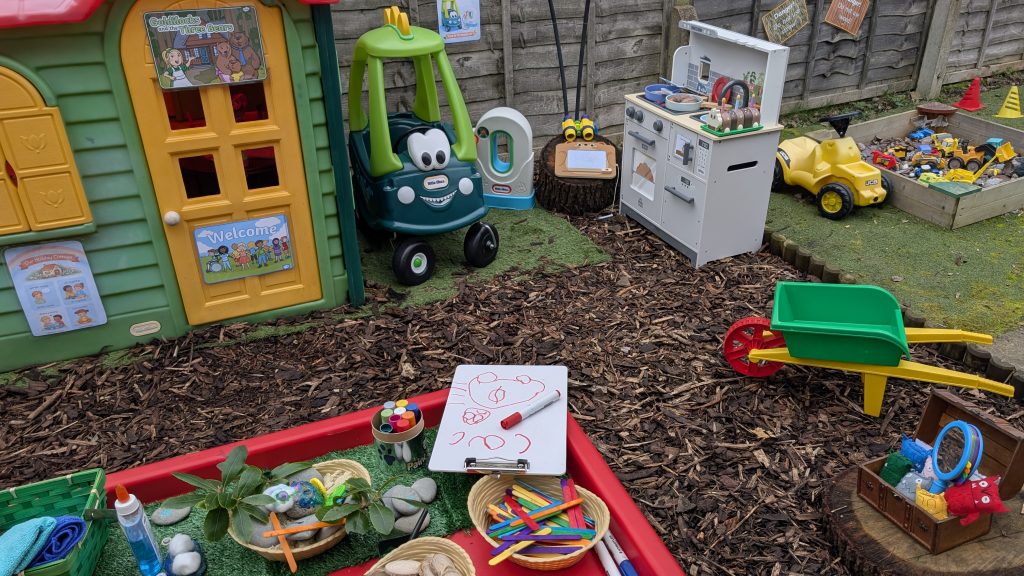
We had recently introduced a new playhouse in the garden. While exploring in the digger pit, the children discovered a large stone and immediately decided that it must be the Grumpy Old Stone from the story.
Without any prompting, they carefully carried the stone into the playhouse and began recreating parts of the narrative. Very quickly the stone was placed onto a plate and became the cake for an imaginary tea party, just as it does in the story.
Later another idea emerged. One child suggested that the stone might like a house of its own. They carried it to a nearby table where magnet tiles were available, and together two children began building a small home for the stone.
Interestingly, in the story a child also makes a home for the stone using different materials, and here the children had remembered that moment and adapted it in their own way.
Seeing how strongly the children were connecting with the story, I decided to follow this interest further. Over the weekend I gathered together a small collection of materials that might support their ideas and curiosity around the stone.
These included coloured buttons, lolly sticks, paint, googly eyes, Play-Doh, baskets, a small treasure box, a miniature door and mark-making equipment. The intention was not to direct the play, but simply to offer materials the children could use if they wished.
When the Story Continued the Following Week
When we returned to the story the following week, the stone was placed on a tray in the garden alongside the new materials.
One child chose to use the drawing board that was already available on the table and began recording a simple plan. This also connected with the letter formation we had recently been practising in sand. The child wrote “cac”, representing cake and returning to the earlier moment in the story where the stone had been turned into a cake.
They then drew a van and explained that the Grumpy Old Stone could travel home inside it so that it could finally be left alone. The child even drew movement lines around the van, something we had been exploring in our drawings the previous term.
At the same time the children’s ideas around the stone continued to develop. They added googly eyes, painted the stone and used lolly sticks as whiskers, gradually transforming the stone into a cat, then changed this into a dog with four legs and a confused expression!
The next day the stone appeared again in imaginative play. The children placed it inside a colander from the mud kitchen, recalling the rocket colander from the story Whatever Next. The stone was tucked up carefully and taken for a walk in the buggy as though it were travelling on a journey.
When Stories Travel Home
The story even continued beyond the setting. One parent later shared that their child had extended the story at home, pretending that the Grumpy Old Stone was travelling to space in a rocket ship, following their own interest in rockets and echoing the rocket journey from Whatever Next.
Moments like this remind us that shared stories rarely stay within the book. They often continue to grow in children’s thinking long after the pages have been closed.
The Stone Soup Investigation
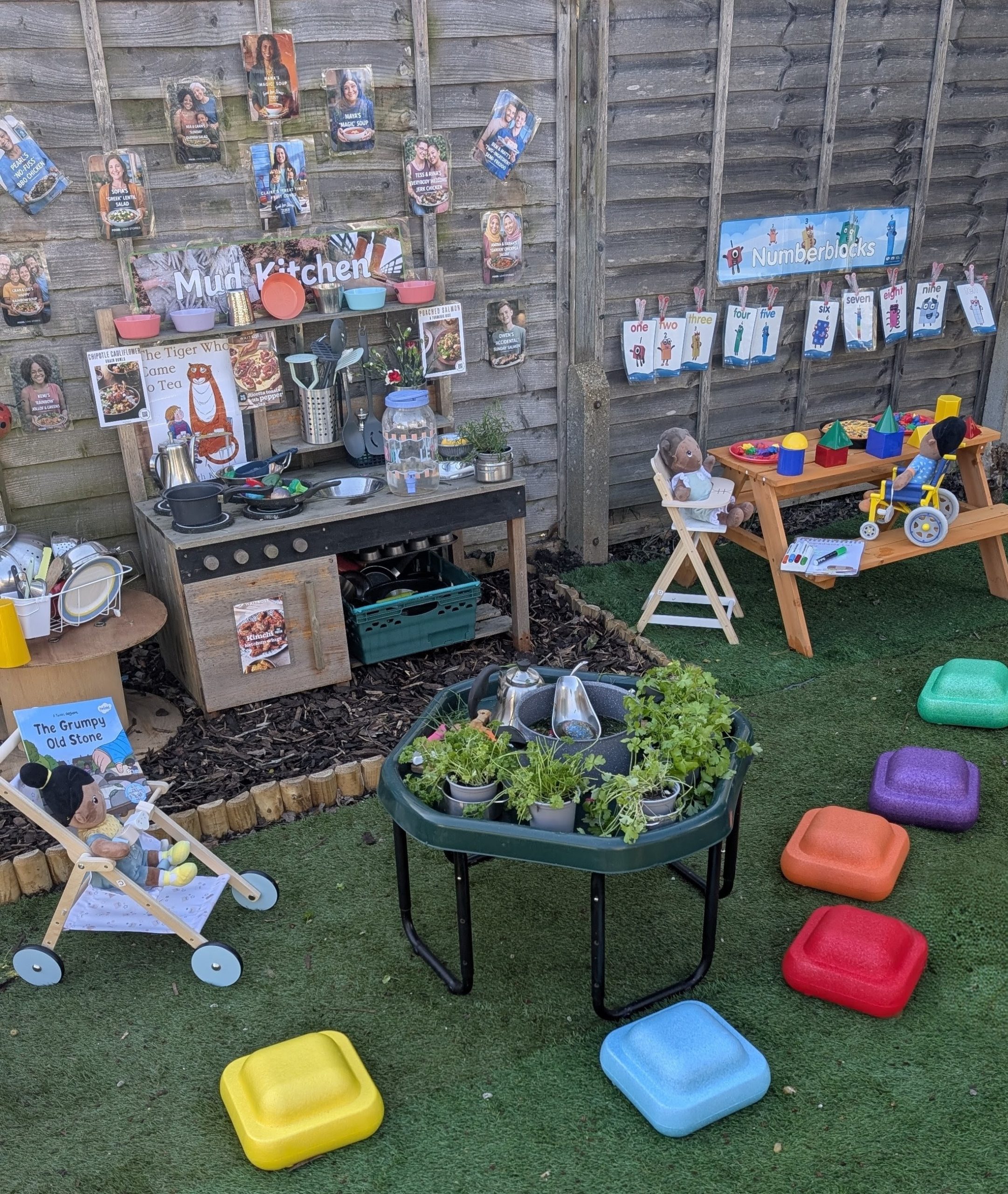
Later in the week the story returned again during outdoor play at the mud kitchen.
The stone was placed in a large bowl beside a tray of herbs and flowers gathered from the garden. Without any direction from adults, the children began combining leaves, stems and petals, deciding what should be added next.
Some began cutting herbs and flowers using the safety scissors and small knives available at the mud kitchen.
Soon bowls of soup began to appear. The children carefully shared their stone soup with adults, friends and even the dolls nearby.
The mud kitchen quickly became a small investigation space where storytelling, imaginative play and exploration blended together.
What had begun as a simple story had gradually become part of the children’s shared play across the week.
Reflection
Across one shared story, the children moved between conversation, mark making, mathematical thinking, physical movement, imaginative play, emotional understanding and early exploration of the wider world, drawing naturally on ideas from across the curriculum.
The learning did not come from a sequence of planned activities. Instead it emerged from slowing down during the story, noticing what children saw in the illustrations and allowing their ideas to guide the direction of exploration.
Most importantly, the story continued to live within the children’s play days later.
Thoughts for Practitioners
It can sometimes feel as though meaningful curriculum coverage requires multiple planned activities or elaborate resources. Experiences like this remind us that depth often comes from staying with something simple.
A well-chosen story can support discussion, movement, investigation and creative thinking when practitioners take the time to pause, notice and extend children’s ideas.
Resources do not need to be complex. They simply need to be accessible and ready when curiosity appears.
Recent professional literature, including the Play Matters report (Bradbury et al., 2025), highlights the importance of play as a foundation for children’s learning and development. Watching the children re-enact The Grumpy Old Stone was a powerful reminder of how stories can inspire language, imagination and collaboration through play.
What This Means for Practice
This experience highlights how learning often grows from shared stories and meaningful conversation. By slowing down during reading and allowing time for ideas to develop through accessible resources and play, the story gradually became part of the children’s thinking.
Over time this was reflected in the children’s play as they recalled key moments from the narrative and adapted them in their own imaginative ways.
When stories are explored with care and curiosity, they rarely end when the book closes.
Instead they continue to reappear in children’s thinking, language and play.
Further Reading
Bradbury, A. (2025) Play Matters: Why Play Matters in Early Childhood.
Early Years Reviews
https://www.early-years-reviews.com/_files/ugd/c871c5_37c8d65a5d6c4f6a981edbb3a0e6310b.pdf