
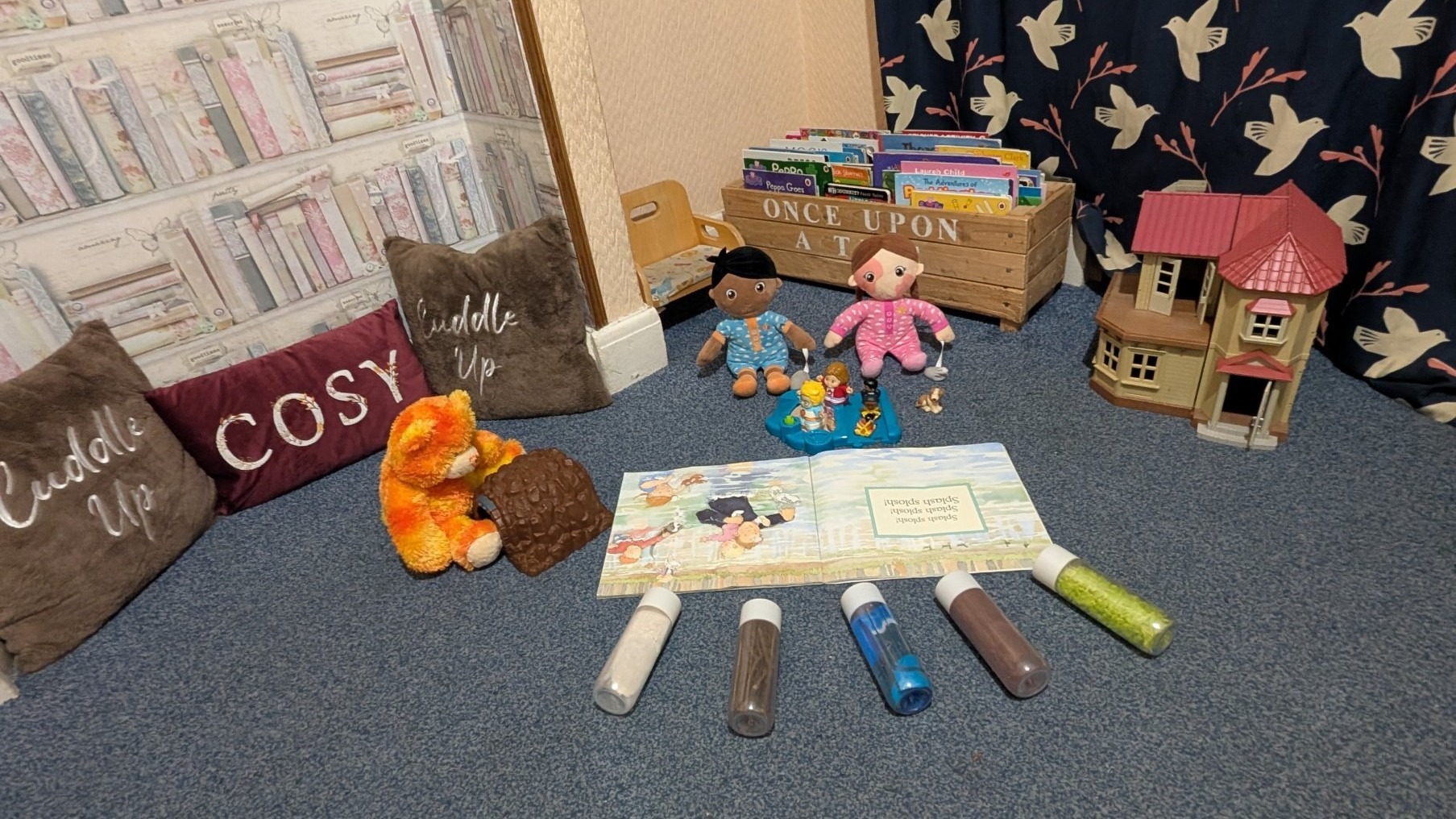
Following movement from 'We’re Going on a Bear Hunt' to 'Rosie’s Walk' and into our drawings...
This term our Little Explorers have been learning about home and belonging as part of our “All About Me” curriculum planning.
An interesting theme emerged early in this journey.
I noticed that words describing where things are and how they move, such as over, under, through, around and inside, kept on reappearing in our play and activities.
The same ideas kept on cropping up through stories, local walks to explore the environment and even the resources the children were choosing independently. Sometimes I decided to bring an idea back deliberately; at other times, spontaneous play provided a reason to return to it.
A familiar journey
One of the books we shared was “We’re Going on a Bear Hunt”. Its repeated rhythm gave a new child who had just joined our setting a fantastic way to participate with his friends.
We patted our hands as the characters moved. We talked about going over, under and through.
After sharing the book, we took our teddy bears into the garden for our own bear hunt and talked about the route they might take. I used the opportunity to introduce simple maps and explore how they can show a route or location.
During the school run that day, the topic of choosing a route came up again. When we had to navigate around a parked vehicle on the path, we talked about going around it and leaving space for other people to get through. This very ordinary moment gave us a fantastic reason to talk about routes, linking to British values as we discussed consideration for others.
Another of our favourite books, “Walking Through the Jungle”, brought the rhythm back again, with different ways of moving: walking, creeping, running and leaping. The animals in the story also gave us an opportunity to talk about emotions and feeling scared.
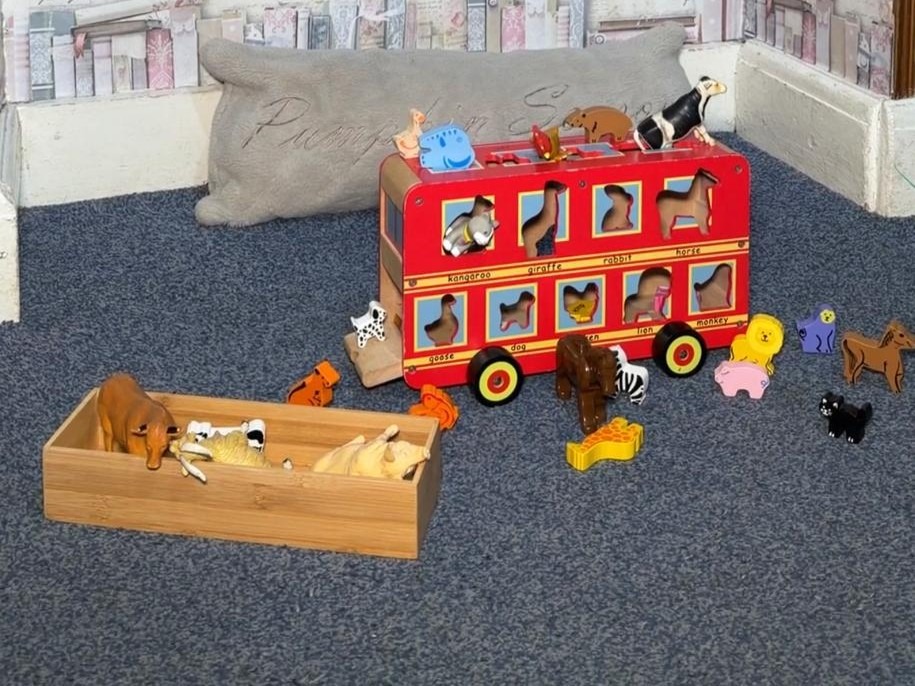
The word “stuck” came up in child-initiated play with our youngest child. As he tried to push wooden animals through the insets in an animal shape-sorting bus, they became stuck. He automatically said “uh-oh”, so I extended this by saying, “Uh-oh, stuck.”
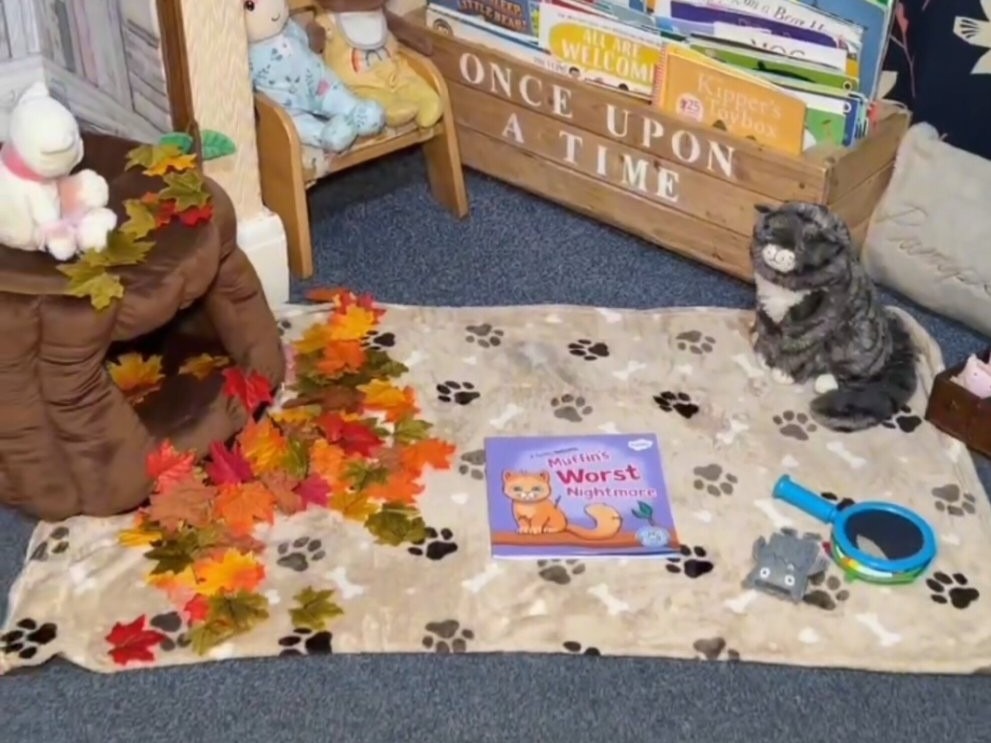
I then revisited this idea using the books “One Duck Stuck” and “Muffin’s Worst Nightmare”, in which the characters also needed help to get free or get down.
We went on to explore spiders and webs using our weaving frames, silk scarves and spiders. We took this idea further by making webs for our spiders using magnetic tiles. When the spiders became stuck in the webs, I heard the word “stuck” creep in again, giving us another real reason to use it spontaneously.
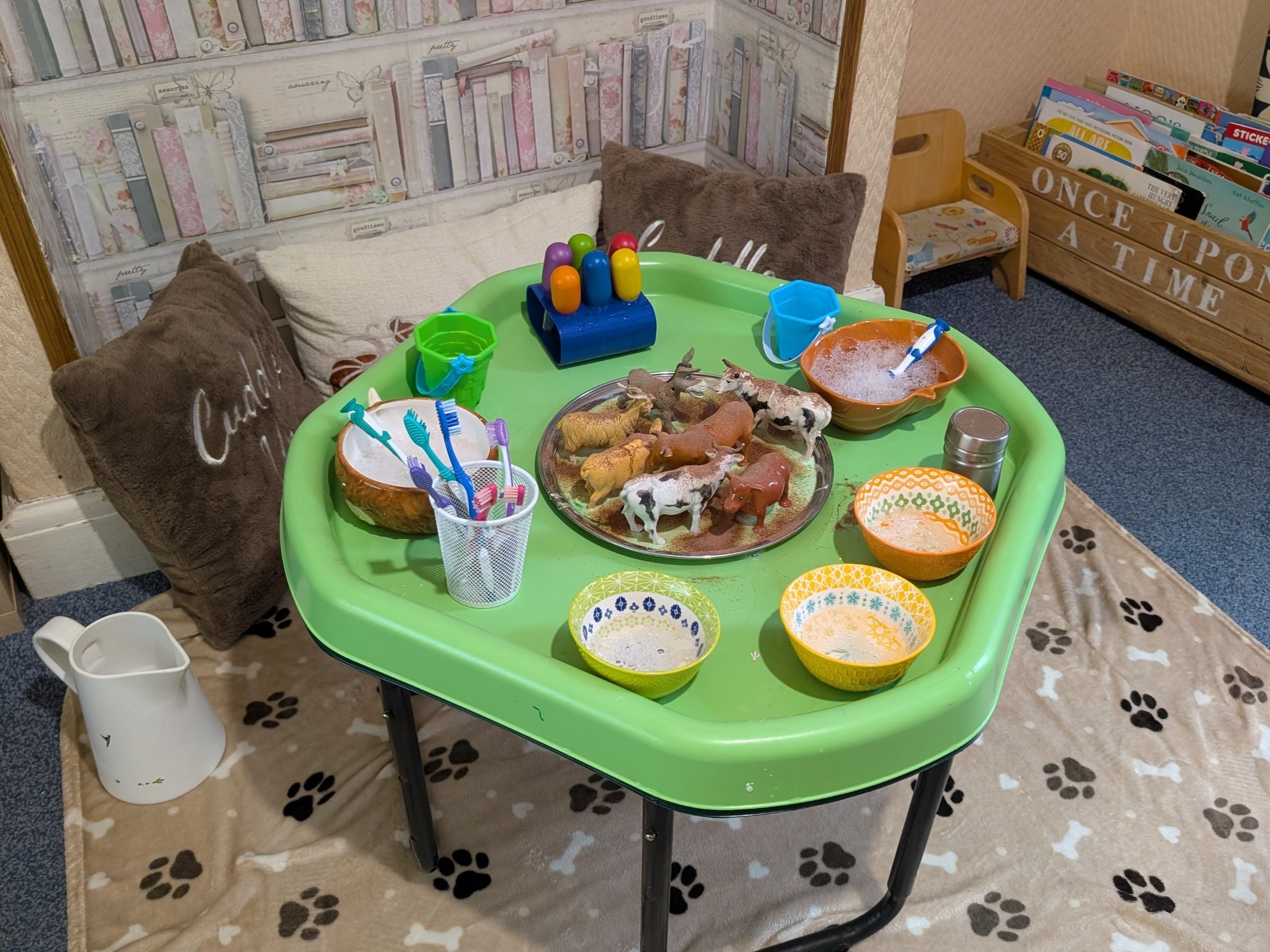
During farm play, animals became “stuck” in the gloop “mud” and needed rescuing and washing. Each time the word reappeared, it had a real meaning in the play at that moment.
Words that came back in play
The word “through” also started to appear beyond our bear hunt book. A child pushed a character through a Duplo window and said “through”. Later, children independently pushed vehicles through a tunnel, spontaneously saying “through tunnel”.
After sharing the autumn book “The Best Gift of All”, another child recalled information from a book about animal homes: moles “dig a hole”. The child made the connection that they could “make a tunnel to go through”.
In the story, Mole travels through the rain to visit Rabbit. We re-enacted this by passing the animals through our play tunnel to see their friend.
Building, buildings and animal homes
Building play provided another opportunity to explore where things could go and how to make them stay there! After building with Duplo, we went for a local walk and looked at the buildings in the area. We talked about roofs, flats, brick walls and letterboxes. We compared a wooden fence, a metal fence and a brick wall. Once home, we shared the familiar book “The Three Little Pigs” and talked throughout about the different materials the pigs used and the best choices.
We then took this play into the garden. The children used a clean, empty butter pot that I just happened to have to hand as a mould to make pretend bricks in the sandpit. It reminded me again how spontaneous opportunities can be so fabulous. As a bonus, it also gave us a chance to talk about recycling and looking after the planet!
We talked about full and empty, practised taking turns, and learnt about adding just the right amount of water to our sand as we focused together on making a wall with this newly discovered resource!
We talked about the shape of the wall, how high it was getting and what might help it stay steady. I introduced the phrase “stable surface” for the first time. There was so much learning in such a simple opportunity.
The children’s interest in building moved naturally towards animal homes, alongside natural conversations about autumn, nocturnal animals and hibernation. One morning, a child chose to build with our magnetic tiles. After some adult modelling, he learnt how to make a cube and then used this idea to make small cube-shaped houses with roofs. When I provided a selection of small-world animals to enhance his play, he became fully engrossed in making a large selection of houses, then repeatedly opening and closing the doors and putting the animals inside to have a rest!
I dug out a simple fact book about animal homes. We talked about rabbits living in burrows, spiders in webs, birds in nests and owls in hollows in trees. The children automatically linked this back to one of our very favourite books, “Owl Babies”. I followed this interest by setting out building stones and a large toy owl. I modelled making the outline of the home and supported the child to build the walls taller, making the space around the owl bigger. The word “stable” came up in this play too.
I revisited this later by demonstrating how to use Geo Pegs to make an enclosure, building around the edge of the foam mat in a similar way. During a spontaneous, child-initiated investigation, the child discovered that a tall tower did not provide a steady place for their toy cow to balance on. I showed how four towers of the same height could be placed together to make a wider, more stable surface. The child then balanced the cow across them. We had stumbled across another real reason to talk about a “stable structure” while building.
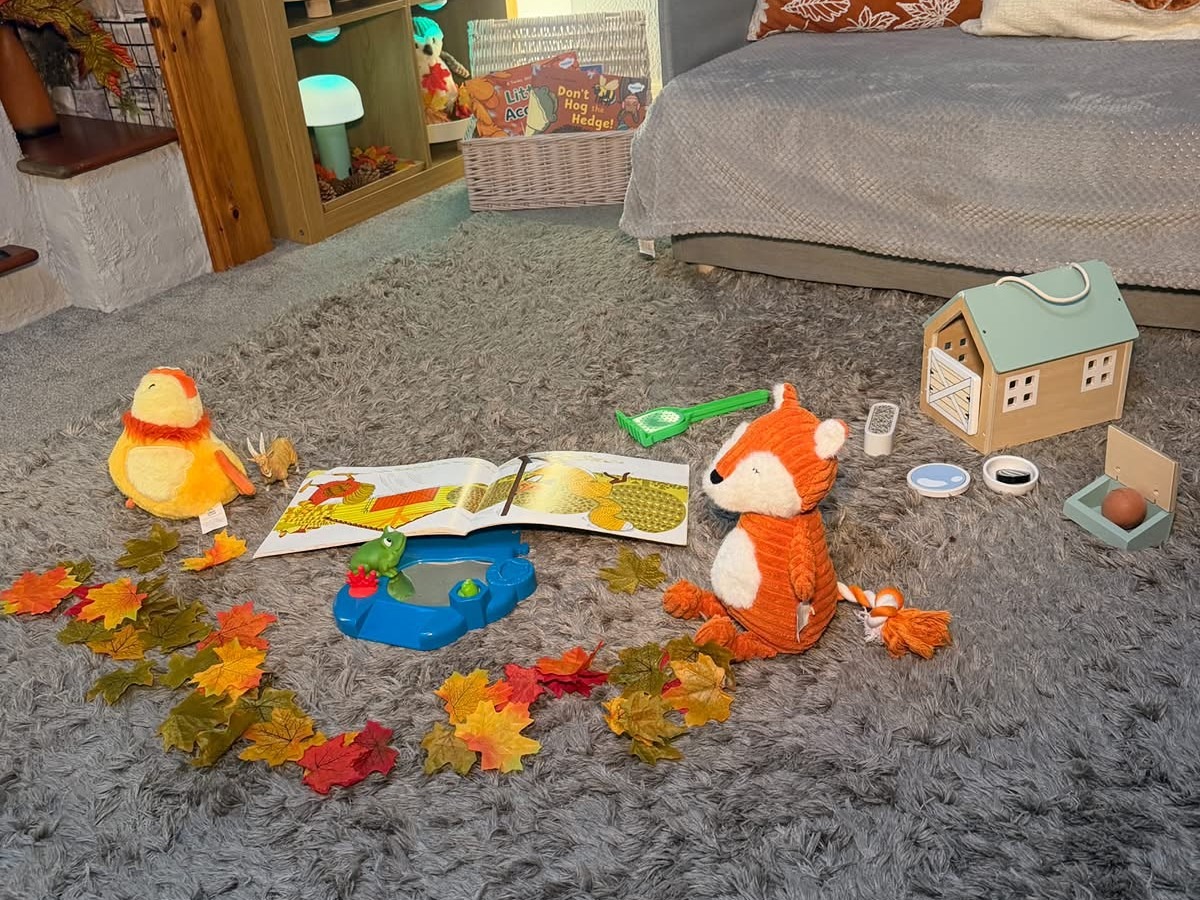
Looking again at “Rosie’s Walk”: an unexpected place to discover more movement!
Last week we shared the book “Rosie’s Walk”. A new hen toy provided a way to act out Rosie’s journey around the farm. I added a pond, and we talked about Rosie going around the pond and while the fox went through it. When Rosie travelled over the haycock and the fox became stuck, I returned to the books “We’re Going on a Bear Hunt” and “One Duck Stuck”, revisiting these ideas.
Looking closely at this book, I was astounded by how much movement the illustrations show. The delicate pencil lines help us see that the fox is leaping, the beehives are tumbling over and the leaves are making rippling patterns across the pond. I had read the book many times before, but I had never really stopped to notice how much work those lines were doing to illustrate the movement.
We looked closely together at the lines, including those showing the rake moving up to hit the fox on the nose. Afterwards, I demonstrated how we could use wiggly lines to draw falling autumn leaves, adding lines to show movement. The children practised on magnetic drawing boards before transferring this new learning to paper, making pointed leaf shapes and adding movement lines. Before long, the children were excitedly drawing bouncing balls, floating balloons and dripping rain, all with the most wonderful movement lines, simply from this spontaneous provocation!
As I thought about the early years outcome of using drawing to represent movement, “Rosie’s Walk” made me realise how easily this can be found in everyday books and carried into drawing, if only we, as practitioners, paused long enough to notice!
Thoughts for practitioners
Once again this term, I’ve noticed that learning we might otherwise plan as an “activity” is already present in our everyday provision. As practitioners, perhaps we need to notice how many of our books show movement within their wonderful illustrations. Everyday experiences, such as a tunnel, a parked vehicle or an animal home, can give us a reason to use positional language naturally. The building resources in our continuous provision, along with the structures around us, can lead us to think about height and stability.
Our role as practitioners is simply to pause, notice what is happening and bring a word or a connection to the front of our thinking when it is useful, helping to make the idea meaningful. Then we can watch for the children to bring these ideas back into their own play, supporting their learning and building on their experiences.
Comments
No comments yet — be the first!